
dinar guru
Dinar Guru
A Simple, Honest Guide to the Iraqi Dinar “RV” Rumor World
Introduction
The phrase dinar guru shows up in search results for one big reason. People want a shortcut. They want to know if the Iraqi dinar will “revalue” and make them rich. That hope creates a whole online space full of bold predictions, countdowns, and secret “intel.” Many posts look confident. Many sound urgent. Many push the same idea: buy dinar now, wait, and cash out huge later.
Here’s the problem. A lot of this space is built on hype, not facts. Regulators have warned about Iraqi dinar schemes for years. Some sellers and promoters push high markups and big promises. This article breaks the topic down in plain English, so you can protect your money and your peace of mind.

What “dinar guru” really means online
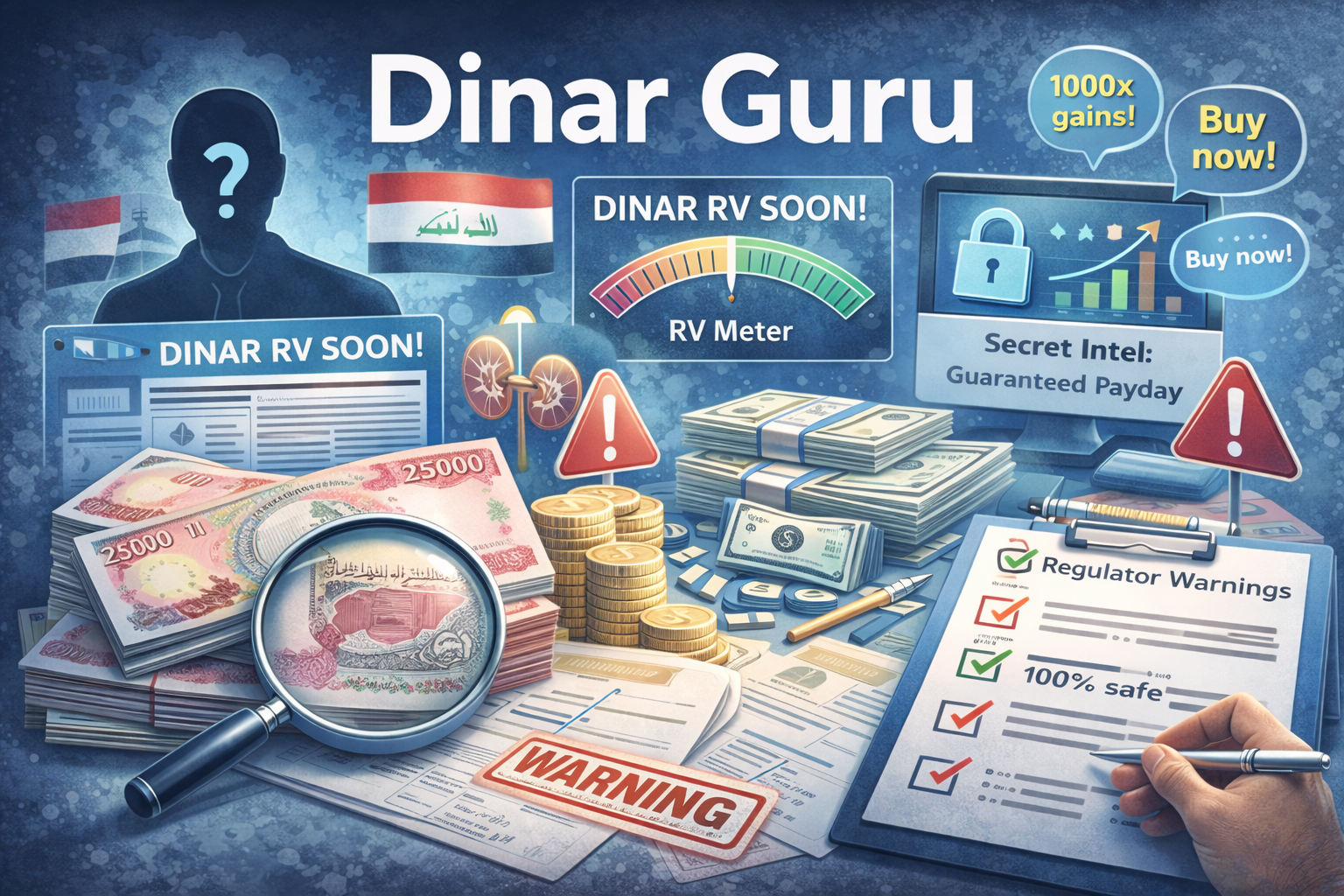
A dinar guru is not a licensed title. It’s an internet label. It usually refers to a person or site that claims special insight about the Iraqi dinar’s future value. Many of these voices talk about an “RV” (revaluation) happening “soon.” Some publish daily “intel” summaries. Some act like they have private contacts inside governments or banks. One popular site even shows an “RV meter” and pushes the idea that a rate change is close.
A key point: being loud online does not equal being right. In real currency markets, big claims need proof. Real proof looks like official statements, official policy documents, and transparent market data. Rumor posts often rely on anonymous sources and vague “bank chatter.” If you treat those posts as entertainment, fine. If you treat them as a plan for your savings, that’s where trouble starts.
Why “Iraqi dinar guru” rumors spread so fast
The keyword iraqi dinar guru blends money and mystery. That mix spreads fast on social platforms. People share stories about someone who bought dinar years ago and is “about to cash out.” The story feels like a hidden door to wealth. It also feels personal, like you discovered something the “system” doesn’t want you to know.
Scam warnings explain why this works. Promoters often sell a dream of extravagant profit, then add pressure with time-based urgency. Many buyers also don’t realize how hard it can be to resell physical dinar in the U.S. Washington’s regulator warned that dinar can be hard to redeem outside Iraq and that many established exchange houses may not convert it. When it’s hard to sell, people hold longer. When people hold longer, rumors keep feeding the hope.

What “Iraq dinar guru” sites usually publish
If you browse iraq dinar guru pages, you’ll see a repeated pattern. There’s a “rate” section, a “guru recap” section, and a “breaking news” vibe. One site shows a claimed official rate and a market rate and frames it like a countdown. Another page talks about “guru” speculation where 1,000,000 dinars could become life-changing money after an “RV.”
This content style has a goal. It keeps you checking back. It also keeps you emotionally invested. The more you read it, the more it feels real. Then a person may buy more dinar “just in case.” That is why you must separate news from narrative. Official currency policy does not work like a social media drama series. It moves through central bank decisions, government budgets, and long-term economic needs.
The reality of the Iraqi dinar exchange rate
The Iraq dinar is not a free-floating currency that moves wildly each day like some emerging market currencies. Iraq’s monetary policy has used a managed approach, and recent reporting around official rates points to stability, not a sudden leap to “$3 per dinar.” One recent local report noted an official rate around 1,320 IQD per $1 and showed market rates in major cities above that level. Another report said the 2026 budget fixed a rate around 1,300 IQD per $1.
On global converters, you’ll still see the dinar valued as a small fraction of one U.S. dollar. This does not mean the dinar can never change. It means the “overnight millionaire RV” story does not match how exchange rate policy works in real life.
How people lose money in dinar guru cycles
Most losses don’t come from the exchange rate moving. Losses come from the deal itself. Some sellers charge big markups and big fees. A finance reference notes that brokers selling Iraqi dinar in cash may charge steep premiums over the official rate, and reselling can be hard with big discounts.
Picture a simple scenario. You buy physical dinar at a 25% premium. Then you try to sell it back and get an offer far below the official rate. You can lose money even if the currency rate stays the same. This is one reason the dinar guru story keeps people stuck. They don’t want to admit a loss. So they keep waiting. Then they keep reading the next “intel” post. That loop is powerful. Breaking it starts with understanding the math and the resale problem.
Dinar Guru Claims vs Reality Checks
| Claim | Reality Check | Why it Matters |
|---|---|---|
| “RV is scheduled this week” | Look for official policy changes, not blog posts. | No official schedule exists. |
| “Banks will cash out at huge rates” | Ask your bank if they exchange IQD at all. | Many places won’t convert physical IQD. |
| “Buy now, price will jump 1,000x” | Check current conversion sources. | Current rates don’t support jumps. |
| “You’re early, only a few holders exist” | Notice how many sites sell the pitch. | Scarcity claims drive impulse. |
| “No risk, Iraq is oil rich” | Exchange rates reflect many factors. | Oil alone isn’t instant value. |
| “Fees are normal” | Compare buy vs sell spreads. | High spreads wipe out gains. |
The “Anonymous Intel” Trap
The phrase dinar guru blogspot pops up because many rumor pages live on simple blog platforms. The look can feel “grassroots,” like it’s a private diary of inside updates. Yet the style often relies on the same tricks: “my source at the bank,” “a contact in Baghdad,” “a secret program,” “a window is opening.”
Regulators have warned that these schemes have lasted a long time because rumor promoters keep shifting the story when nothing happens. Some even use fake authority. The U.S. Securities and Exchange Commission has described cases where people claimed access to top secret programs tied to Iraqi dinar and oil deals while soliciting investors. The lesson is simple: anonymous intel is not a source. It’s a sales tool.
Common Red Flags to Scan For
- ⚠️ “Guaranteed” returns or guaranteed timing
- ⚠️ Pressure to buy quickly, with “last chance” language
- ⚠️ Claims that banks are “ready to exchange at huge rates” without proof
- ⚠️ Requests for wire transfers, money orders, cash on delivery
- ⚠️ Claims that dinar can be redeemed easily in the U.S. without limits
Regulators in Washington warned consumers about websites asking for checks, wires, money orders, and cash on delivery. Another regulator warning explained how long-lived dinar schemes keep pulling new buyers in. If you see these signs, treat it like you would treat a suspicious email. Back away first, then verify.
How to verify information the safe way
If you want to research without getting pulled into hype, use three sources only: central bank materials, credible finance references, and regulator warnings. A Central Bank of Iraq bulletin shows official pricing guidance for banks and institutions and gives a view into managed rates. For investor safety, state securities regulators have issued clear warnings about Iraqi dinar schemes.
For basic rate tracking, tools like XE and Wise show general market conversion levels. If a claim can’t be supported by these types of sources, treat it as a rumor. You can still read it, but don’t act on it.
Real-world cases that show the risk is not “just talk”
The dinar space is not only internet chatter. There have been investigations and legal actions around dinar sales operations. The Federal Bureau of Investigation posted a victim information page tied to an investigation involving the sale of Iraqi dinar through Sterling Currency Group. A court appendix describes how dinar stayed popular with retail buyers due to recurring “revalue” rumors, even though the rate stayed mostly stable and the currency is pegged.
This is a big point for anyone who follows dinar guru updates. Even if buying dinar is legal in some contexts, the marketing around it can be deceptive. The danger often sits in the promises, the fees, and the pressure tactics, not in the paper bills alone.
A calmer way to think about IQD
If you want a realistic frame, think of the Iraqi dinar as a managed currency tied to Iraq’s economic and policy choices, not a hidden jackpot. A finance explainer points out that the biggest concern is scams and the difficulty of selling dinar, with regulators warning for years.
So what should a normal person do with iraqi dinar guru claims? Keep your life stable. Don’t bet rent money on a rumor. If you already own dinar, focus on facts. What did you pay? What spread would you face if you sell? What is your exit path? If you don’t have a clear exit path, you don’t have an investment plan. You have a hope plan. Hope is not evil. It’s just not a strategy.
My personal lens after years of watching “guru” cycles
Here’s what I’ve noticed. The dinar guru world rarely says, “I was wrong.” It resets the story. If the week passes, the story becomes “next week.” If a policy doesn’t change, the story becomes “it’s hidden.” That keeps the audience hooked.
I also notice how often the conversation avoids hard questions. No one wants to talk about spreads, resale limits, or fees. No one wants to talk about how you convert dinar in the U.S. without losing a big chunk. Those boring details are exactly where the truth lives.
So I treat guru talk like weather chatter from strangers. It might be fun. It might be noisy. It should not guide your savings. If you want real growth, build a plan with diversified assets and clear rules. If you want to follow dinar chatter, keep it as a side curiosity.
Frequently Asked Questions
A dinar guru is an online personality or site that claims special insight into Iraqi dinar revaluation timing or rates. It’s not a regulated role. Many posts rely on anonymous “intel” and prediction cycles. The safer approach is to rely on official policy sources and regulator warnings.
Most iraqi dinar guru claims are not verifiable. Regulators have warned for years about dinar schemes and exaggerated profit promises. If a claim can’t be checked through official sources, treat it as a rumor, not a plan.
It may be difficult. A Washington regulator alert said many established currency exchange houses and banks may not convert dinar to U.S. dollars, and redemption may only be practical in Iraq. Always confirm with your bank before buying any physical currency for “investment.”
There’s no official proof of a sudden massive jump. Recent reporting around official rates points to managed levels in the 1,300 IQD per $1 area, not a leap to multi-dollar IQD values. Big overnight “RV” stories are a common feature of long-running schemes.
About the Author
