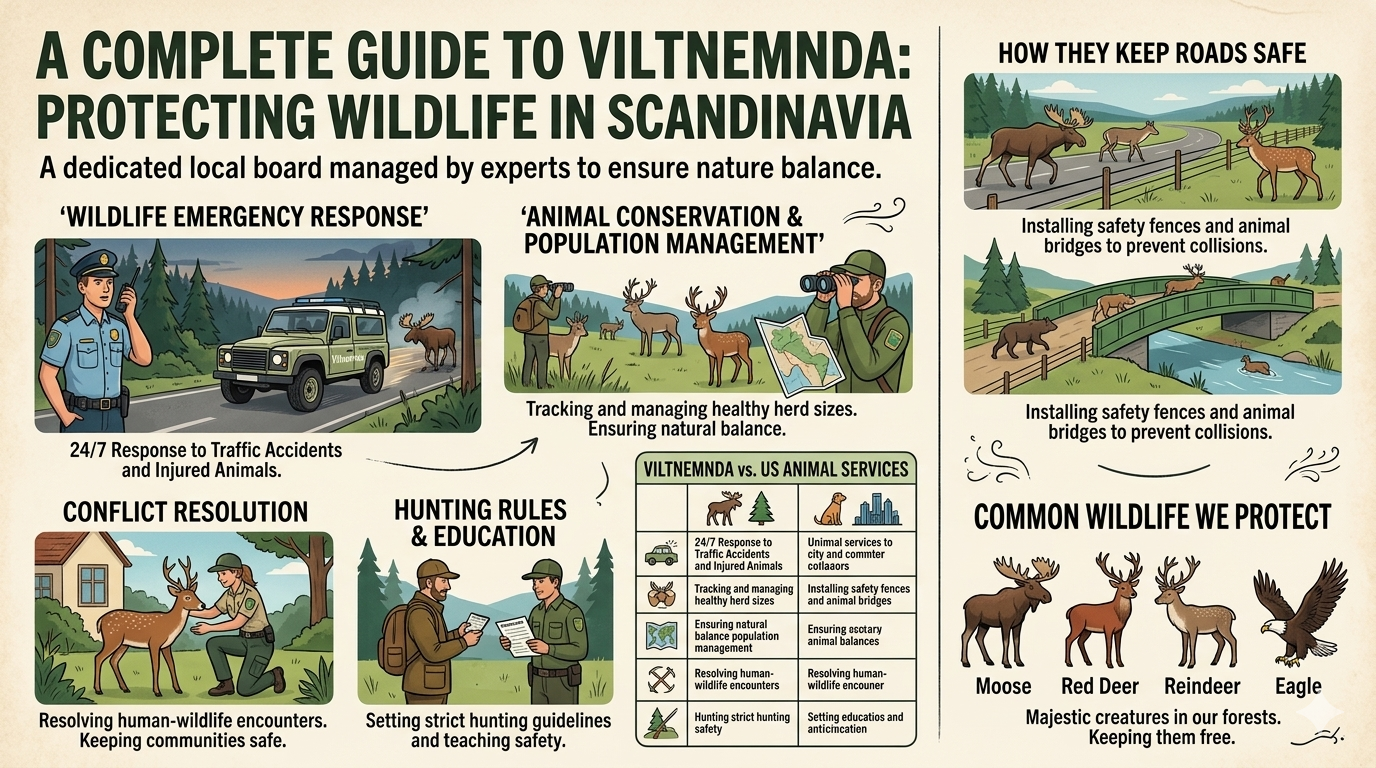
viltnemnda
Norway’s Wildlife Management Boards:
If you have ever wondered who decides how many moose can be hunted in a Norwegian valley, or how local communities balance the needs of farmers with the protection of wolves and lynx, you are curious about viltnemnda. This Norwegian term refers to local wildlife management boards that play a crucial role in conserving wildlife while supporting sustainable use of natural resources. The idea behind viltnemnda is beautifully simple: the people who live closest to the land and its animals should have a voice in how those animals are managed. These boards bring together farmers, hunters, landowners, and conservationists to make decisions about hunting quotas, predator management, and habitat protection.
For anyone interested in how communities can come together to manage wildlife responsibly, understanding viltnemnda offers a window into one of the most democratic and effective systems in the world. In this article, we will explore everything you need to know about viltnemnda—from its history and structure to the important decisions that shape the landscapes of Norway.
The concept of viltnemnda may be unfamiliar to readers outside Norway, but it represents a powerful approach to environmental governance. Instead of leaving wildlife decisions solely to distant government agencies, viltnemnda places authority in the hands of local people who have generations of knowledge about the land. Farmers understand how wildlife affects their crops and livestock. Hunters track animal populations throughout the year. Conservationists bring expertise about ecological balance and biodiversity. By bringing these voices together, viltnemnda creates decisions that are both scientifically sound and locally accepted.
Whether you are a student of environmental policy, a hunter interested in how quotas are set, or simply someone who cares about how humans and wildlife coexist, learning about viltnemnda will give you a fresh perspective on conservation that puts people at the center.
What Is Viltnemnda? Understanding the Basics
At its heart, viltnemnda is a Norwegian term that translates to “wildlife board” or “game board.” It refers to local committees established by law to manage wildlife populations within a defined geographic area, typically at the municipal or regional level. These boards are not just advisory—they have real decision-making power. They set annual hunting quotas for species like moose, deer, and grouse. They make recommendations on predator control when conflicts arise with livestock.
They also contribute to conservation planning, helping to protect vulnerable species and important habitats. The members of viltnemnda are ordinary people who live and work in the area, appointed by local councils to represent a mix of interests. This structure ensures that decisions are grounded in local reality, not just in scientific reports written far away.
Why does viltnemnda matter so much? Because wildlife management is not just about animals—it is about people. Farmers need to protect their sheep from wolves. Hunters want healthy populations of game. Outdoor enthusiasts want to see a variety of wildlife. Conservationists want to preserve biodiversity for future generations. Viltnemnda provides a forum where these different perspectives can be heard, debated, and balanced. The board meets regularly, often several times a year, especially during the periods when hunting quotas are set.
They gather data from wildlife surveys, listen to input from community members, and then make decisions by majority vote. This process builds trust. When people see that their neighbors—people who share their land and their challenges—are making the decisions, they are far more likely to accept and support those decisions.
The History and Origins of Viltnemnda
The roots of viltnemnda run deep in Norwegian culture. For centuries, rural communities in Norway managed hunting and fishing through informal local agreements. Families knew which areas they could hunt, and there was an unwritten understanding about not taking too many animals. As Norway modernized, these informal systems were formalized into law. The modern viltnemnda system was established in the mid-20th century as part of a broader effort to give local communities a formal role in natural resource management. The idea was simple: centralized government could set broad goals, but local people should have the authority to make decisions that fit their specific conditions. This approach was revolutionary at a time when many countries were moving toward top-down environmental management.
Over the decades, viltnemnda has evolved to meet new challenges. In the 1980s and 1990s, large predators like wolves, bears, and lynx began returning to areas where they had been absent for generations. This created new conflicts between conservation goals and traditional farming practices. Viltnemnda became the battleground where these tensions were negotiated. Today, these boards are at the center of some of the most heated debates in Norwegian environmental policy. Yet even when decisions are controversial, the viltnemnda system provides a framework for resolution that is grounded in local democracy.
Its history shows that giving people a stake in managing their natural resources leads to more sustainable outcomes than imposing rules from above. That legacy continues to shape how Norway balances conservation with rural livelihoods.
How Viltnemnda Is Structured
The structure of viltnemnda reflects its commitment to local representation and democratic decision-making. Typically, each viltnemnda consists of five to nine members, appointed by the municipal or county council. The members serve for fixed terms, often four years, and are chosen to reflect the diversity of interests in the community. A typical board might include a farmer, a hunter, a landowner, a conservationist, and a representative of the general public. The chairperson is usually someone with experience in local governance or natural resource management.
The board also has access to professional expertise—wildlife biologists, foresters, and legal advisors who help ensure decisions are based on sound science and comply with national laws.
This structure is designed to prevent any single interest group from dominating the board. By requiring a mix of backgrounds, viltnemnda ensures that decisions are made after considering multiple perspectives. Meetings are open to the public, and community members can submit written comments or speak at hearings. This transparency builds trust. After each meeting, the board’s decisions are published, along with the reasoning behind them. If someone disagrees with a decision, they can appeal to higher authorities, but appeals are rare because the process is seen as fair.
The structure of viltnemnda is a model of how to balance expertise with democracy, ensuring that decisions are both informed and legitimate in the eyes of the community.
Key Responsibilities of Viltnemnda
The responsibilities of viltnemnda are wide-ranging and have a direct impact on both wildlife populations and the people who live alongside them. One of the most important tasks is setting annual hunting quotas. Each year, the board reviews population data for species like moose, red deer, roe deer, and small game. They consider factors such as winter survival rates, habitat conditions, and the goals of local hunters. Then they decide how many animals can be harvested sustainably.
These quotas are not arbitrary—they are carefully calibrated to maintain healthy populations while allowing hunting as a cultural and economic activity. Viltnemnda also sets guidelines for predator management. When wolves or lynx kill livestock, farmers can apply for permits to remove problem animals, and the board decides whether to grant those permits.
Beyond hunting and predator control, viltnemnda plays a critical role in conservation. The board may recommend areas to be set aside as wildlife reserves, or it may advise on land-use planning to protect migration corridors. In some regions, viltnemnda oversees projects to restore habitat for threatened species. Another key responsibility is public outreach. The board organizes meetings, distributes information about wildlife populations, and educates the public about how to coexist with large predators. By taking on these diverse responsibilities, viltnemnda acts as the bridge between national wildlife policies and the realities of life in local communities. Their decisions affect everything from the price of meat at the market to the survival of rare species—a weighty responsibility that they carry with dedication.
The Decision-Making Process of Viltnemnda
How does viltnemnda go from gathering information to making a final decision? The process is designed to be thorough, transparent, and inclusive. It begins with data collection. Wildlife authorities conduct population surveys using methods like aerial counts, camera traps, and hunter reports. This scientific data provides a baseline. Next, the board invites input from the community. Farmers, hunters, and other stakeholders can submit written comments or speak at public meetings. Viltnemnda members also draw on their own local knowledge—observations of animal behavior, changes in land use, and the specific challenges faced by neighbors. This combination of science and lived experience gives the board a complete picture of the situation.
Once all information is gathered, the board meets to discuss the options. Members debate the trade-offs. Should the moose quota be increased to reduce damage to young forests? Should a wolf pack be removed to protect sheep, or should farmers receive compensation instead? These are difficult questions with no easy answers. After discussion, the board votes. The majority decision becomes official, and the reasoning is documented. If a member disagrees, they can note their dissent, but the decision stands.
The entire process—from data collection to final vote—is guided by the principle that decisions should be made as close to the people affected as possible. This is the essence of viltnemnda: democratic, transparent, and rooted in the belief that local people are the best stewards of their natural resources.
Science and Local Knowledge Working Together
One of the most remarkable features of viltnemnda is how it integrates scientific expertise with traditional and local knowledge. Wildlife biologists provide data on population sizes, birth rates, and migration patterns. This information is essential for setting sustainable hunting quotas and understanding the impacts of predators. But scientists cannot know everything. They do not see which fields are being damaged by deer, or which pastures are most vulnerable to wolf attacks.
That is where local knowledge comes in. Farmers, hunters, and landowners bring firsthand observations that no survey can capture. They know the land intimately—the hidden valleys where moose gather, the streams where beavers build dams, the habits of the lynx that passes through each spring.
When viltnemnda brings science and local knowledge together, the result is more robust decision-making. The scientific data provides a factual foundation, while local insights add nuance and context. For example, population surveys might show that the moose population is within target levels, but local hunters might report that calves are smaller than usual due to poor winter conditions. That information might lead the board to reduce the quota slightly to ensure the herd stays healthy.
By valuing both types of knowledge equally, viltnemnda avoids the pitfalls of relying solely on either. The board becomes a place where experts and community members learn from each other, building mutual respect and better outcomes for wildlife and people alike.
Challenges Facing Viltnemnda Today
Despite its strengths, viltnemnda faces significant challenges in the modern era. Perhaps the most difficult is the ongoing conflict between predator conservation and rural livelihoods. Wolves, bears, lynx, and wolverines have made strong comebacks in Norway, a conservation success story. But for farmers, especially those with free-ranging sheep, these predators mean real economic losses. Viltnemnda is caught in the middle, trying to balance national conservation goals with the needs of local communities.
Decisions about predator removal are often controversial, attracting national attention and sometimes legal challenges. Board members face intense pressure from both sides, and the process can become emotionally charged.
Another challenge is adapting to climate change. Warmer winters, changing vegetation, and shifts in migration patterns are altering wildlife populations in unpredictable ways. Viltnemnda must make decisions with incomplete information, knowing that the conditions next year may be very different from this year. There is also the challenge of funding. Many boards operate with limited budgets, making it difficult to conduct the population surveys they need or to hire expert advisors.
Despite these challenges, viltnemnda continues to function, adapting its approaches and finding creative solutions. The resilience of these boards is a testament to the commitment of their members and the enduring value of local democracy in natural resource management.
Viltnemnda and Community Engagement
One of the greatest strengths of viltnemnda is its deep connection to the communities it serves. Unlike centralized agencies that may feel distant and unresponsive, these boards are made up of neighbors and friends. People know the members, and members know the people. This creates a foundation of trust that is essential for effective wildlife management. When viltnemnda makes a difficult decision, community members may not always agree, but they understand that the decision was made by people who share their concerns and values. This trust is built through ongoing engagement. The board holds public meetings, sends out newsletters, and is available to talk with anyone who has questions.
Community engagement also takes the form of education. Viltnemnda often partners with schools to teach children about wildlife and conservation. They may host workshops on how to use electric fencing to protect livestock, or how to report predator sightings. By involving the community in these ways, viltnemnda helps build a culture of stewardship. People learn to see themselves as active participants in wildlife management, not just as recipients of decisions made elsewhere. This sense of ownership leads to better outcomes. When a community feels responsible for its wildlife, it is more willing to make the sacrifices needed for conservation. Viltnemnda provides the structure for that shared responsibility to flourish.
Comparing Viltnemnda to Other Wildlife Management Systems
How does viltnemnda compare to wildlife management systems in other countries? In many places, wildlife decisions are made by centralized government agencies, often with limited local input. While these systems can be efficient, they sometimes struggle to gain public acceptance. Farmers may feel that distant bureaucrats do not understand their struggles with predators. Hunters may resent quotas that seem arbitrary. Viltnemnda offers an alternative: local boards with real authority, accountable to the community. This model has proven remarkably effective at building trust and achieving conservation goals. Studies have shown that in areas where viltnemnda is active, there is higher compliance with hunting regulations and greater support for predator conservation.
Other countries have experimented with similar community-based approaches. In parts of North America, tribal councils manage wildlife on reservation lands. In Africa, community conservancies give local people a stake in protecting wildlife. But few systems integrate local decision-making as thoroughly as viltnemnda. It is not just advisory—it has legal authority. And it is not limited to one region—it covers the entire country. For policymakers and conservation practitioners around the world, viltnemnda offers valuable lessons in how to design wildlife management systems that are both effective and democratic.
By combining science, local knowledge, and community engagement, it provides a model that could inspire reforms elsewhere.
Success Stories and Positive Impacts
Despite the challenges, there are many success stories that show the positive impact of viltnemnda. In some regions, careful management by the board has led to thriving moose populations that support both hunters and tourism. In others, collaborative efforts between farmers and conservationists have reduced conflicts with predators. For example, in areas where viltnemnda worked with sheep farmers to install predator-proof fencing and provide compensation for losses, attacks on livestock decreased significantly. At the same time, wolf populations have stabilized at levels that conservationists consider healthy. These outcomes would not have been possible without the board’s ability to bring different stakeholders together and find solutions that work for everyone.
Another success story is the restoration of habitats. In some municipalities, viltnemnda has used hunting quotas to reduce overpopulation of deer, which in turn allowed forests to regenerate. Native plants returned, and with them came birds and insects that had been declining. These ecological benefits are the result of decisions made by local boards, guided by scientific data and local observations. Viltnemnda also plays a role in preserving cultural traditions. Hunting has deep roots in Norwegian culture, and by ensuring sustainable hunting opportunities, these boards help maintain traditions that have been passed down through generations.
In these ways, viltnemnda contributes not just to wildlife conservation, but to the social and cultural fabric of rural Norway.
The Future of Viltnemnda
Looking ahead, viltnemnda faces both opportunities and challenges. Climate change will require more flexible and adaptive management strategies. New technologies, such as improved GPS tracking and online citizen science platforms, could provide boards with better data to inform their decisions. There is also growing interest in making viltnemnda more inclusive, ensuring that a wider range of voices—including young people, indigenous Sámi communities, and urban residents—are represented. Some have called for increasing the resources available to boards, so they can do their work more effectively. These reforms could strengthen the system for the future.
At the same time, the fundamental principles of viltnemnda—local empowerment, democratic decision-making, and integration of science and local knowledge—are as relevant as ever. In a world where environmental challenges often seem overwhelming, viltnemnda offers a reminder that solutions can be built from the ground up. When people have a say in managing the natural resources they depend on, they take ownership of the outcomes. As Norway continues to balance conservation with rural development, viltnemnda will remain a vital institution.
Its future depends on continued commitment from communities, support from government, and the willingness of all stakeholders to work together. That commitment has sustained the system for decades, and it will carry it forward.
Complete Viltnemnda Information Table
| Category | Details |
|---|---|
| Full Name | Viltnemnda (Norwegian Wildlife Management Board) |
| Type | Local government committee |
| Purpose | Manage wildlife populations, set hunting quotas, address human-wildlife conflicts |
| Geographic Scope | Municipal and regional levels across Norway |
| Members | Typically 5–9 members appointed by local councils |
| Representation | Farmers, hunters, landowners, conservationists, general public |
| Key Responsibilities | Setting hunting quotas, predator management, conservation measures, public engagement |
| Decision Basis | Scientific data, local knowledge, stakeholder input |
| Meeting Frequency | Several times per year; more often during quota-setting periods |
| Oversight | Regional and national wildlife authorities |
| Challenges | Balancing conservation and agricultural interests, adapting to climate change |
| Strengths | Local engagement, democratic decision-making, integration of diverse perspectives |
| Historical Roots | Evolved from traditional Norwegian resource management practices |
Frequently Asked Questions
1. What does viltnemnda mean in English?
Viltnemnda translates to “wildlife board” or “game board” in English. It refers to local committees in Norway that make decisions about hunting quotas, predator management, and conservation within their regions. These boards are made up of community members and have real decision-making authority.
2. Who serves on a viltnemnda?
Members of viltnemnda are appointed by local municipal or county councils. They are chosen to represent a mix of interests, including farmers, hunters, landowners, conservationists, and the general public. This ensures that different perspectives are considered in wildlife management decisions.
3. What decisions does viltnemnda make?
Viltnemnda sets annual hunting quotas for species like moose, deer, and grouse. It also makes decisions about predator control when wolves or lynx threaten livestock. Additionally, it advises on conservation measures, habitat protection, and land-use planning that affects wildlife.
4. How does viltnemnda balance different interests?
Viltnemnda balances interests by including diverse members on the board and by seeking input from the community through public meetings and written comments. Decisions are based on a combination of scientific data and local knowledge, with the goal of finding solutions that are acceptable to different stakeholders while meeting conservation goals.
5. Is viltnemnda unique to Norway?
While similar community-based wildlife management approaches exist in other countries, the viltnemnda system is a distinctive feature of Norwegian wildlife governance. It reflects Norway’s tradition of local democracy and its commitment to involving communities in decisions that affect their livelihoods and environment.
6. How can the public engage with viltnemnda?
The public can engage with viltnemnda by attending open meetings, submitting written comments on proposed decisions, and contacting board members with questions or observations. Many boards also hold informational events and partner with local schools to educate the community about wildlife issues.
Conclusion: The Power of Local Voices in Wildlife Management
The story of viltnemnda is a powerful reminder that the best decisions about our natural world are often made by the people who live closest to it. These local wildlife boards have been entrusted with an enormous responsibility—to balance the needs of farmers, hunters, conservationists, and wildlife itself. They do this not with distant authority, but with open meetings, careful debate, and a commitment to listening. In a time when environmental conflicts often seem intractable, viltnemnda offers a model of how to move forward: not by imposing top-down solutions, but by empowering communities to find their own way. The members of these boards are ordinary people who step up to do extraordinary work, and their dedication deserves recognition.
As we look to the future, the principles behind viltnemnda—local knowledge, democratic participation, and respect for diverse perspectives—will only become more important. Climate change, biodiversity loss, and shifting land use patterns will require flexible and adaptive management. Systems that treat local communities as partners, not obstacles, will be better equipped to meet these challenges. Whether you are a student, a policymaker, or simply someone who cares about how we share this planet with wildlife, the story of viltnemnda offers hope and inspiration.
The next time you hear about a decision affecting wolves in Norway or moose in a Norwegian valley, remember that it was likely made not in a distant capital, but in a local meeting room, by neighbors who know the land and its animals as well as anyone. That is the quiet power of viltnemnda.
| Read More Informative Blogs Like This. Tap Here 👉 Acamento: The Art of Finishing Touches |
About the Author