teach me first comic
The Complete Beginner’s Roadmap to Creating Your Debut Book
You have stories inside you. You see them play out like movies in your mind. But when you sit down to make your first comic, the blank page stares back. Where do words go? How many panels fit on a page? Should you write everything first or draw immediately? These questions stop talented people before they start. This guide answers them practically. You will finish reading with specific next steps, not vague encouragement. Creating comics combines writing, visual art, and design thinking. That sounds intimidating, but each skill builds through practice. You do not need art school degrees or expensive software.
You need persistence, honest self-assessment, and a willingness to make imperfect work. Every professional comic artist started exactly where you are now. The difference between those who publish and those who dream lies in finishing small projects. Your first comic will not be your best work. It will be your most important work. It proves you can complete the cycle from idea to finished product. That confidence carries into project two, three, and beyond. Let us begin building your comic creation foundation.
Understanding What Makes Comics Unique
Comics occupy a distinct storytelling space. They are not illustrated novels where pictures decorate text. They are not storyboards for films waiting to happen. Comics use sequential art, meaning images arranged in deliberate order create meaning through combination and contrast. The space between panels, called the gutter, activates your reader’s imagination. When panel one shows a raised fist and panel two shows a shattered window, your mind bridges the action. No artist drew the punch. You did, mentally. This participation makes comics intimate and engaging. Writers new to the medium often overwrite, filling panels with captions and dialogue. They distrust the visual silence. Resist this urge.
Comics show rather than tell by nature. A character’s slumped posture conveys defeat faster than narration stating “she felt defeated.” Learn to think in visual beats. Ask yourself what single image carries this moment. Then ask what image creates tension or release following it. The “teach me first comic” request usually comes from prose writers or visual artists separately. Prose writers must loosen their grip on description. Visual artists must strengthen narrative structure. Both transitions challenge different comfort zones. Recognize which background you bring. Compensate accordingly by studying the complementary skill.
Finding Your Story Worth Telling
Your first comic should finish quickly. Not because you lack ambition, but because completion teaches what planning cannot. Choose a story you can tell in eight to twelve pages. This constraint forces clarity. What moment changes your protagonist? Identify that turning point. Build backward asking what setup makes that change meaningful. Build forward asking what resolution satisfies the setup. Personal experience generates authentic details. You understand your emotional truth even in fictional settings. A story about moving cities carries your knowledge of cardboard boxes, goodbye hugs, and unfamiliar streets. Borrow those specifics. Readers feel the difference between researched and lived description.
Test your concept with the one-page summary. Write the entire plot in three paragraphs: beginning, middle, end. If you cannot summarize simply, your story lacks focus. This exercise prevents the common beginner error of starting drawing immediately. Visual excitement tempts us to skip writing. Resist. A weak story beautifully drawn disappoints doubly. Write first. Revise twice. Then thumbnail. This sequence seems slower but actually accelerates production. You solve story problems in text documents faster than redrawn pages.
Writing Comics, Not Prose
Comic scripts differ from screenplays and fiction. They must guide artists, including yourself, through visual decisions. Two formats dominate: full script and plot-first. Full script details panel descriptions, dialogue, and sound effects completely. Plot-first provides story beats letting the artist determine panel breakdowns. Beginners should use full script. It forces you to visualize specifically. You discover pacing problems before drawing begins. Format your script with page numbers, panel numbers, description, and dialogue clearly separated. This organization prevents confusion during production. Dialogue in comics must earn its space. Speech bubbles cover artwork. Every word reduces visual information shown.
Edit aggressively. Read dialogue aloud. Does it sound like human speech? Or like exposition disguised as conversation? Silence carries weight in comics. Characters not speaking create tension. Environmental sounds establish mood without narration. Study how Alan Moore or Brian K. Vaughan handle quiet moments. Notice how often they let images breathe without text overlay. Your first script will overwrite. Everyone’s does. The revision process involves cutting, not adding. Challenge every caption and bubble. Does this advance character or plot? If neither, delete it. Trust your artist, even when the artist is you, to show what words merely describe.
Visual Storytelling Without Art School
You believe your drawing skills prevent comic creation. This belief stops more potential artists than actual inability. Comics require clarity, not beauty. Readers follow stories when they understand action, emotion, and sequence. They abandon stories when confusion interrupts flow. Start with stick figures. Seriously. Draw your entire comic as simple shapes first. Can you tell who speaks? Can you follow movement? If yes, your storytelling functions. Refinement comes later. If no, no amount of detail fixes unclear structure. Camera angles control reader experience. Eye-level shots create connection and equality. Low angles make characters imposing or heroic. High angles diminish subjects, making them vulnerable or insignificant.
Close-ups intensify emotion. Wide shots establish environment and isolation. Vary your angles to maintain visual interest. Static, eye-level medium shots bore readers quickly. Study film storyboards for composition ideas. Movies and comics share visual language extensively. Foreground, middle ground, and background layering create depth. Overlapping figures suggest spatial relationships. These techniques require observation, not innate talent. Draw from life daily. Sketch people in coffee shops, pets sleeping, trees against sky. Build visual vocabulary before applying it to invented scenes. Your first comic art improves dramatically if you maintain this practice consistently.
Designing Characters People Remember
Memorable characters begin with silhouette recognition. In complete darkness, backlit against bright windows, your character should remain identifiable through shape alone. Batman’s pointed ears and cape drape create instant recognition. Mickey Mouse’s circular ears work similarly. Design your characters as black shapes first. Adjust until distinctive. Then add internal details. Costume communicates personality and function immediately. A character in rumpled suits suggests different lives than one in pristine military uniforms. Consider practicality. Fighters need movement freedom. Adventurers need storage and weather protection. Pure aesthetic choices without functional consideration break immersion.
Color psychology influences reader response. Red signals danger, passion, or power. Blue suggests calm, trust, or coldness. Yellow attracts attention, conveying energy or warning. Limit your palette initially. Too many colors confuse and cheapen appearance. Two or three dominant colors per character create cohesion. Consistency matters more than complexity. Your character must look the same on page one and page ten. Create model sheets showing front, side, and three-quarter views. Note specific color values. Reference these constantly while working. Nothing destroys comic immersion like characters changing appearance between panels. Your first comic benefits from simple, consistent design over elaborate, unachievable detail.
Mastering Panel Flow and Pacing
Panels are your time control. Large panels slow reading, emphasizing moments. Small panels accelerate action, creating urgency. The grid system provides beginner-friendly structure. Three tiers of three panels each equals nine panels per page. This classic layout guides eye movement naturally left-to-right, top-to-bottom. It prevents the confusion of experimental layouts before you understand fundamentals. Establish your grid, then break it intentionally. A full-page splash panel interrupts rhythm for impact. An elongated horizontal panel suggests panoramic scope. Small, numerous panels create staccato pacing. Match panel count to story moment. Conversations use fewer, larger panels letting dialogue breathe.
Action sequences multiply panels, showing incremental movement. Gutters, the spaces between panels, require consistent width. Variable gutters confuse reading order. Standard gutter width ranges one-eighth to one-quarter inch depending on page size. Maintain this religiously. Panel borders also communicate. Solid black lines contain normal reality. Irregular, jagged borders suggest dreams, memories, or supernatural events. White borders against black backgrounds create floating, timeless quality. These conventions developed over decades. Use them knowingly. Your first comic succeeds when readers forget they are reading sequential art and simply experience the story. Seamless panel flow achieves this invisibility.
Tools That Match Your Budget
Software options overwhelm beginners with features and pricing. Start free, upgrade when limitations actually hinder progress. Krita offers professional painting tools without cost. It handles comics specifically with panel templates and perspective guides. GIMP provides Photoshop alternatives for image editing and coloring. Both run on modest computers without subscription fees. Inkscape manages vector graphics for crisp line art and lettering. These three free programs cover complete comic production. Paid options include Clip Studio Paint, the industry standard for comic illustration. Its panel tools, perspective rulers, and tone libraries justify costs for serious practitioners. Adobe Photoshop remains coloring and production standard, though subscriptions accumulate.
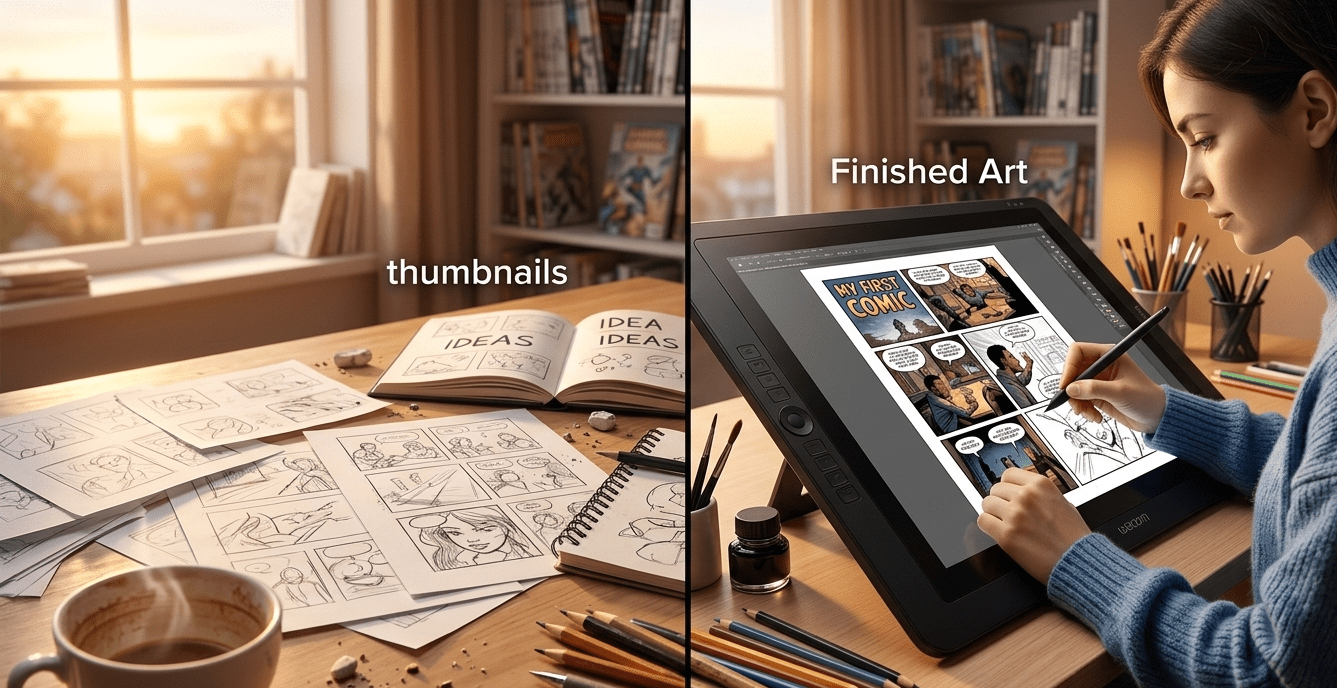
Traditional media mixed with digital workflow suits many artists. Pencil thumbnails and roughs on paper, then scan for digital inking and coloring. This hybrid approach leverages tactile drawing comfort with digital editing flexibility. Hardware requirements stay minimal initially. Any tablet computer or graphics tablet works. Expensive Cintiq displays help professionals but do not create talent. Your phone camera digitizes traditional sketches adequately. Focus budget on time, not equipment. The best tools are those you use daily without friction. Experiment across options. Settle when workflow feels natural and sustainable. Upgrade when specific limitations block your vision, not when marketing suggests you should.
The Thumbnail Method Professionals Use
Thumbnails are tiny sketches, usually two by three inches, representing complete pages. They look rough, almost embarrassingly so. They save months of wasted effort. Professionals thumbnail extensively because rewriting at thumbnail stage costs hours. Redrawing finished pages costs weeks. Draw your entire comic as thumbnails before touching final art. Use stick figures. Label emotions and camera angles. Write dialogue roughly. Read the sequence. Does the story flow? Do page turns create suspense? Are character positions consistent? Fix problems now. Thumbnails reveal pacing issues invisible in scripts. A conversation that read quickly takes four pages visually. Action that seemed brief requires more breakdown. Adjust panel counts and page divisions accordingly. Iterate thumbnails multiple times.
First pass establishes basic sequence. Second pass refines compositions. Third pass adds dialogue placement and sound effects. Only then begin pencils. This discipline separates amateurs from professionals. Amateurs rush to final art, discovering structural problems too late. Professionals embrace the ugly thumbnail phase knowing it produces better final work efficiently. Your first comic deserves this methodical approach. The investment feels slow initially but prevents the demoralization of discarded finished pages. Thumbnails are where comics truly get made. Everything afterward is execution.
Production and Publishing Realities
Finishing art satisfies creatively but leaves distribution unanswered. Print specifications confuse beginners unnecessarily. Standard American comic size measures approximately six and five-eighths by ten and one-quarter inches. Bleed areas extend one-eighth inch beyond trim lines. Resolution requirements demand three hundred dots per inch for print quality. These technical details matter when preparing files. Webcomics bypass print complexity entirely. Platforms like Webtoon, Tapas, and GlobalComix host content freely. They provide built-in audiences and monetization options. Webtoon’s vertical scrolling format specifically suits phone reading. Consider your audience location. Print comics reach convention attendees and comic shop regulars. Webcomics access global readers instantly.
Hybrid approaches work too. Build webcomic followings, then collect chapters into print volumes through Kickstarter or print-on-demand services. Printing small runs locally lets you test markets without massive investment. IngramSpark and similar services distribute to bookstores with setup fees but no inventory requirements. Research each option’s revenue splits and rights terms. Some platforms claim excessive intellectual property control. Read contracts carefully or consult publishing lawyers for significant projects. Your first comic benefits from completion and sharing, not perfect distribution strategy. Publish somewhere, anywhere, to establish the habit of releasing work publicly.
Building Sustainable Creative Habits
One finished comic matters more than ten perfect ideas. The gap between aspiring and working creators lies in consistent practice. Set small daily goals. One page of thumbnails. One panel of finished art. One paragraph of script revision. Small completions compound. Missing one day makes two easier. Maintain streaks carefully. Creative work requires physical sustainability. Eye strain, back pain, and repetitive stress injuries end careers prematurely. Take hourly breaks. Stretch. Maintain ergonomic workspace setups. These investments enable decades of creation. Finishing beats perfecting.
Your first comic contains flaws you see clearly upon completion. This awareness signals growth. Start the next project immediately applying lessons learned. Do not rewrite the first comic endlessly. It represents your skill at that moment, not your potential. File it, print it, move forward. Community sustains individual creators. Join online forums, local comics groups, or social media communities. Share works in progress. Accept constructive criticism. Celebrate others’ releases. Isolation breeds doubt and stagnation. Connection provides accountability and inspiration. Your creative journey continues across many projects. This first comic initiates that lifelong practice. Begin today.
FAQs:
What materials do I need to start my first comic? You need paper, pencils, and commitment. Free software like Krita handles digital creation. Expensive tools do not create better stories. Start immediately with available resources.
How long should my first comic be? Aim for eight to twelve pages. This length teaches complete production cycles without overwhelming you. Finish short projects before attempting longer works.
Do I need to draw well to make comics? Clarity matters more than beauty. Readers follow clear stick figures before confusing detailed art. Practice improves skill, but storytelling fundamentals transcend drawing ability.
Should I write the script or draw first? Write complete scripts first. Thumbnail visually after writing. This sequence prevents story problems that require redrawing finished pages.
How do I publish my finished comic? Webcomic platforms like Webtoon offer free hosting. Print-on-demand services create physical copies without inventory investment. Choose based on your audience and goals.
| Read More Informative Blogs Like This. Tap Here 👉 Doujen Moe: Exploring the Phenomenon |
About the Author