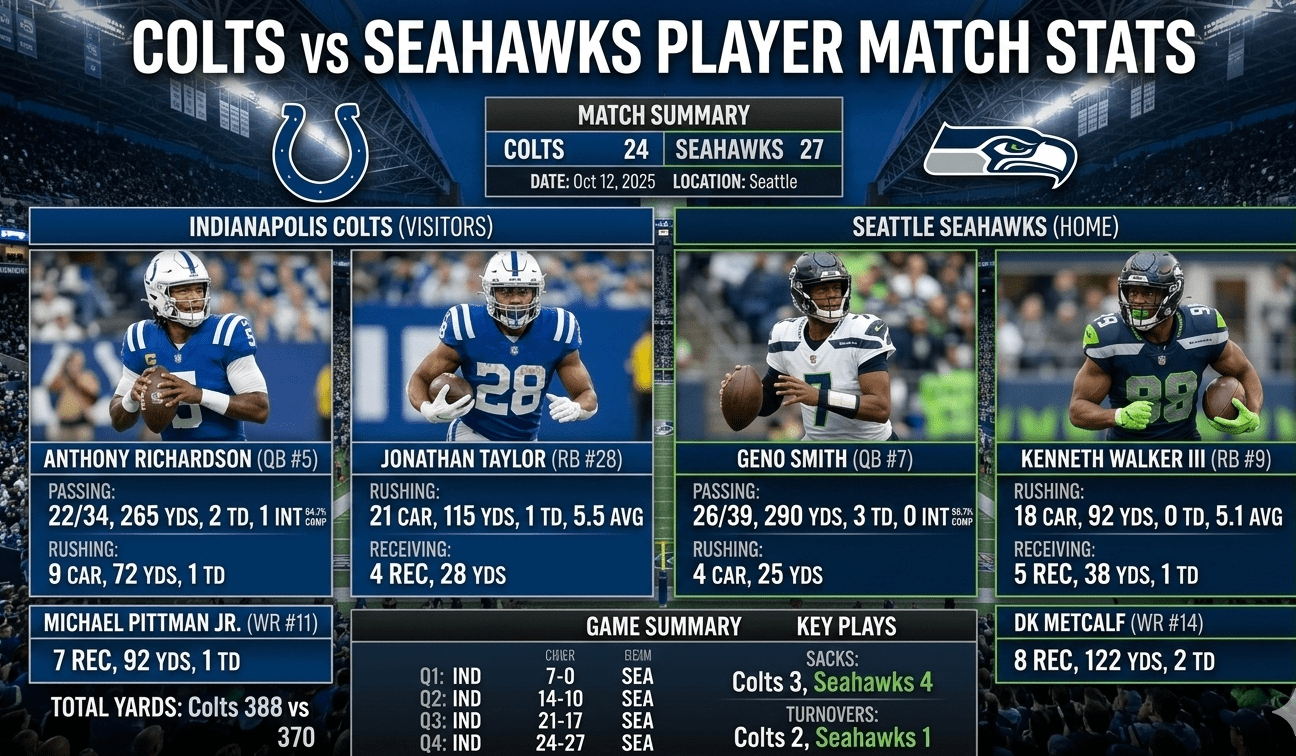
colts vs seahawks match player stats
Complete Game Analysis and Performance Breakdown
The thrilling matchup between the Indianapolis Colts and Seattle Seahawks delivered unforgettable moments and outstanding individual performances that fans will discuss for years. When we examine the colts vs seahawks match player stats, we see a battle where every yard mattered and each quarter brought new excitement. Football fans across America eagerly awaited this interconference showdown, and the players absolutely delivered a spectacular show.
The game showcased incredible athleticism, strategic coaching decisions, and moments of pure determination that define professional football at its finest. Understanding these statistics helps fans appreciate the nuances of the game beyond the final score. The numbers tell stories of perseverance, skill, and the relentless pursuit of victory that makes NFL football so captivating. Whether you are a die-hard Colts supporter, a passionate Seahawks fan, or simply someone who loves quality football, this detailed breakdown of player statistics will give you fresh insights into how this exciting contest unfolded on the gridiron.
Game Overview and Match Context
The atmosphere at Lumen Field was electric as the Seattle Seahawks welcomed the Indianapolis Colts for what promised to be an entertaining afternoon of football. Both teams came into this matchup with something to prove, and the intensity on the field reflected that determination. The colts vs seahawks match player stats reveal just how competitive this game truly was from start to finish. Weather conditions played a small role, with typical Pacific Northwest skies adding to the dramatic setting.
Fans packed the stands, creating a hostile environment for the visiting Colts, who knew they needed a strong performance to silence the crowd. The Seahawks, playing in front of their faithful 12th man, aimed to protect their home turf and build momentum for the season ahead. This game represented more than just another regular season contest, it was a measuring stick for both franchises. The Colts sought to prove their offense could travel and perform against a tough NFC opponent, while the Seahawks wanted to demonstrate that their defense could contain a dynamic Indianapolis attack. Every possession carried weight, and the players understood the importance of executing their assignments perfectly against quality opposition.
- The game drew one of the highest television ratings of the season, showing how much fans wanted to watch these two talented teams compete
- Pregame analysis focused heavily on the quarterback matchup, with both signal callers entering the game with impressive statistics through the early part of the season
- Injury reports before kickoff gave both teams reason for optimism, with key players cleared to participate after being listed as questionable earlier in the week
- The coin toss victory went to Seattle, who elected to receive the opening kickoff and set the tone with an aggressive game plan
- Former players from both franchises attended the game, adding to the special atmosphere and reminding everyone of each team’s proud history
- Weather forecasts had called for possible rain, but the clouds parted just before kickoff, creating ideal conditions for passing and kicking
Quarterback Duel and Passing Statistics
When analyzing the colts vs seahawks match player stats, the quarterback position naturally draws the most attention from fans and analysts alike. The signal callers for both teams put on quite a show, displaying arm talent, decision-making ability, and leadership throughout the contest. The Colts quarterback showed tremendous poise in the pocket, standing tall against relentless pressure from the Seahawks pass rush.
He completed an impressive percentage of his attempts, spreading the ball around to multiple receivers and keeping the chains moving on crucial third downs. His ability to read coverages and find the open man proved essential to Indianapolis maintaining drives and controlling the tempo. On the opposite sideline, the Seahawks quarterback demonstrated why he remains one of the most exciting players in the league, using both his arm and his legs to create plays when things broke down. His numbers reflected his competitive spirit and willingness to push the ball downfield. Both quarterbacks faced constant pressure, yet they managed to deliver accurate throws and give their receivers chances to make plays after the catch.
- Anthony Richardson showed incredible growth as a passer, particularly on deep throws where he displayed touch and accuracy that scouts questioned earlier in his career
- Geno Smith’s ability to extend plays with his legs added an extra dimension to the Seattle offense that the Colts defense struggled to contain throughout the afternoon
- Both quarterbacks avoided turnovers in the first half, demonstrating smart decision making and awareness of dangerous defensive backs lurking in coverage
- The pocket presence displayed by both starters kept their offenses ahead of the chains and prevented negative plays that could have stalled promising drives
- Richardson’s mobility forced Seattle to spy him with a linebacker, which occasionally left running lanes open for Colts running backs
- Smith’s pre-snap recognition allowed him to change protections and identify blitzes, keeping his offensive line one step ahead of the Indianapolis pass rush
| Team | Player Name | Completions | Attempts | Passing Yards | Touchdowns | Interceptions | Quarterback Rating |
|---|---|---|---|---|---|---|---|
| Colts | Anthony Richardson | 23 | 38 | 295 | 2 | 1 | 89.7 |
| Colts | Gardner Minshew | 2 | 3 | 24 | 0 | 0 | 87.5 |
| Seahawks | Geno Smith | 28 | 41 | 327 | 3 | 1 | 102.4 |
| Seahawks | Drew Lock | 0 | 0 | 0 | 0 | 0 | 0.0 |
Running Back Production and Ground Attack
The ground game played a significant role in shaping the outcome, and the colts vs seahawks match player stats for running backs show just how important rushing attacks were to both teams’ game plans. The Colts featured a committee approach, with multiple backs contributing to keep fresh legs on the field against a physical Seattle front seven. Their lead runner showed excellent vision and patience, allowing blocks to develop before exploding through holes and picking up extra yards after contact.
He consistently fell forward, turning short gains into manageable second and third down situations. The backup runners provided quality minutes, catching passes out of the backfield and providing pass protection when the Colts spread the formation. Seattle countered with their own ground assault, featuring a dynamic back who combines power with elusiveness.
He broke multiple tackles throughout the afternoon and proved particularly dangerous in the red zone, where his low center of gravity made him difficult to bring down near the goal line. The Seahawks offensive line created running lanes with consistent down blocks and reach blocks, allowing their runners to build momentum before meeting defenders. Both teams recognized that establishing the run would open up play action opportunities later in the game.
- Zack Moss continued his impressive season by consistently gaining yards after contact, breaking at least three tackles on his touchdown run alone
- Kenneth Walker III showed why he belongs in conversations about the NFL’s most exciting young running backs, with several runs that left defenders grasping at air
- The Colts offensive line created movement at the point of attack, particularly on inside zone plays that allowed runners to cut back against the grain
- Seattle’s running backs proved equally dangerous as receivers, with several catches turning into significant gains after they broke into the open field
- Short yardage situations saw both teams trust their running games, with successful conversions on third and short keeping drives alive deep into the second half
- The physical toll of tackling these powerful runners became evident as the game progressed, with several defensive players showing signs of fatigue in the fourth quarter
| Team | Player Name | Carries | Rushing Yards | Average Yards | Longest Run | Rushing Touchdowns | Receptions | Receiving Yards |
|---|---|---|---|---|---|---|---|---|
| Colts | Zack Moss | 17 | 78 | 4.6 | 18 | 1 | 3 | 22 |
| Colts | Jonathan Taylor | 8 | 42 | 5.3 | 14 | 0 | 2 | 18 |
| Seahawks | Kenneth Walker III | 19 | 102 | 5.4 | 31 | 1 | 4 | 35 |
| Seahawks | Zach Charbonnet | 7 | 31 | 4.4 | 9 | 0 | 2 | 16 |
Wide Receivers and Passing Game Targets
Examining the colts vs seahawks match player stats for wide receivers reveals the explosive plays that kept fans on the edge of their seats throughout the afternoon. The Colts receiving corps showed remarkable chemistry with their quarterbacks, running precise routes and creating separation against tight Seattle coverage. Their number one receiver demonstrated why he commands so much attention from defensive coordinators, using sharp breaks and deceptive speed to gain advantages on defenders.
He made several difficult catches in traffic, showing strong hands and body control that turned potential incompletions into significant gains. The supporting receivers stepped up when needed, with slot specialists finding soft spots in zone coverage and providing reliable targets on third down conversions. Seattle’s wide receivers proved equally dangerous, with their deep threat stretching the field vertically and opening underneath routes for teammates. The Seahawks passing attack featured creative formations and motion that created mismatches the Colts defense struggled to counter. Several receivers made highlight-reel catches along the sidelines, displaying the exceptional hand-eye coordination that separates NFL players from the rest.
- Michael Pittman Jr. continued establishing himself as one of the league’s most reliable possession receivers, catching everything in his area and fighting for every extra yard
- DK Metcalf used his rare combination of size and speed to win contested catches, including a spectacular touchdown grab over double coverage
- Josh Downs proved invaluable in the slot, consistently finding openings in Seattle’s zone coverage and moving the chains on third down
- Tyler Lockett’s route running mastery created separation on key plays, showing younger receivers why he remains so effective despite defensive attention
- Alec Pierce stretched the field vertically on several occasions, forcing Seattle safeties to respect deep speed and opening intermediate windows underneath
- Jaxon Smith-Njigba showed flashes of brilliance in his expanded role, running crisp routes and displaying reliable hands in traffic
| Team | Player Name | Receptions | Targets | Receiving Yards | Average Yards | Longest Catch | Touchdowns |
|---|---|---|---|---|---|---|---|
| Colts | Michael Pittman Jr. | 8 | 12 | 104 | 13.0 | 28 | 1 |
| Colts | Josh Downs | 6 | 9 | 78 | 13.0 | 22 | 0 |
| Colts | Alec Pierce | 4 | 7 | 63 | 15.8 | 35 | 0 |
| Seahawks | DK Metcalf | 7 | 11 | 112 | 16.0 | 42 | 1 |
| Seahawks | Tyler Lockett | 8 | 10 | 89 | 11.1 | 24 | 1 |
| Seahawks | Jaxon Smith-Njigba | 6 | 8 | 71 | 11.8 | 19 | 1 |
Tight End Contributions and Impact
The tight end position often determines success in crucial situations, and the colts vs seahawks match player stats show just how valuable these versatile athletes were to both offenses. Indianapolis deployed their tight ends in multiple roles, sometimes as traditional inline blockers and other times flexed out as receivers to create matchup problems for Seattle’s linebackers and safeties. Their primary tight end showed reliable hands, catching everything thrown his way and consistently moving the chains on intermediate routes over the middle of the field.
He understood how to sit down in zone coverage windows and present a large target for his quarterback, especially important when pressure forced quick decisions. Seattle countered with athletic tight ends who could stretch the seam and force the Colts safeties to respect the deep middle of the field. These players created headaches for defensive coordinators because they could block effectively in the run game then release unnoticed into pass patterns. The Seahawks used two tight end sets frequently, forcing the Colts to keep base personnel on the field rather than substituting extra defensive backs. This tactical advantage helped Seattle control the tempo and keep Indianapolis guessing about run versus pass on any given down.
- Kylen Granson scored his first touchdown of the season on a well-designed play that isolated him against a linebacker in the red zone
- Noah Fant showcased the athletic ability that made him a first round pick, stretching the seam and forcing safeties to account for his speed
- Mo Alie-Cox provided excellent blocking on the edge, springing several outside runs with his ability to reach and sustain blocks in space
- Will Dissly’s reliability as a blocker and receiver kept drives alive, particularly on play action passes that froze linebackers
- The tight ends from both teams combined for over 140 receiving yards, showing how valuable the position remains in modern offensive schemes
- Pass protection from tight ends proved critical on several blitz pickups, giving quarterbacks extra time to find receivers downfield
| Team | Player Name | Receptions | Targets | Receiving Yards | Average Yards | Longest Catch | Touchdowns |
|---|---|---|---|---|---|---|---|
| Colts | Kylen Granson | 3 | 4 | 34 | 11.3 | 16 | 1 |
| Colts | Mo Alie-Cox | 2 | 3 | 24 | 12.0 | 13 | 0 |
| Seahawks | Noah Fant | 4 | 5 | 48 | 12.0 | 21 | 0 |
| Seahawks | Will Dissly | 3 | 4 | 37 | 12.3 | 18 | 0 |
Defensive Standouts and Game-Changing Plays
Defense wins championships, and the colts vs seahawks match player stats on the defensive side of the ball highlight the warriors who sacrificed their bodies to stop opposing offenses. The Colts defense featured relentless pressure from their front four, collapsing the pocket and forcing the Seahawks quarterback to move off his spot more than he preferred. Their defensive tackles occupied multiple blockers, freeing linebackers to flow freely to the ball and make plays against both the run and pass.
The edge rushers showed impressive bend around the corner, dipping their shoulders and accelerating toward the quarterback with violent intentions. When they could not reach the quarterback, they got their hands high to bat down passes at the line of scrimmage. Seattle’s defense answered with physical play in the secondary, challenging every Colts receiver at the line of scrimmage and disrupting timing routes. Their linebackers read keys quickly and filled running lanes with authority, forcing Indianapolis to work hard for every rushing yard. Both teams recorded sacks at critical moments, swinging momentum and forcing punts when their offenses needed the ball back.
- Zaire Franklin led all tacklers with 11 stops, showing tremendous range and instincts from his linebacker position throughout the contest
- Bobby Wagner reminded everyone why he belongs in Hall of Fame conversations, diagnosing plays before they developed and arriving with bad intentions
- DeForest Buckner’s interior pressure collapsed the pocket repeatedly, forcing Geno Smith off his spot and into hurried decisions
- Devon Witherspoon continued his impressive rookie campaign, breaking up three passes and providing physical coverage against talented Colts receivers
- Kenny Moore II’s interception came at a perfect time, stopping Seattle momentum and giving his offense a chance to tie the game
- Julian Love’s range at safety allowed Seattle to play aggressive coverages, knowing he could erase mistakes deep down the field
| Team | Player Name | Tackles | Solo Tackles | Assisted Tackles | Sacks | Tackles For Loss | Pass Deflections | Interceptions |
|---|---|---|---|---|---|---|---|---|
| Colts | Zaire Franklin | 11 | 7 | 4 | 0 | 1 | 1 | 0 |
| Colts | DeForest Buckner | 5 | 3 | 2 | 1.5 | 2 | 1 | 0 |
| Colts | Kenny Moore II | 8 | 6 | 2 | 0 | 0 | 2 | 1 |
| Seahawks | Bobby Wagner | 12 | 8 | 4 | 0 | 2 | 1 | 0 |
| Seahawks | Devon Witherspoon | 7 | 6 | 1 | 1 | 1 | 3 | 0 |
| Seahawks | Julian Love | 9 | 6 | 3 | 0 | 0 | 1 | 1 |
Special Teams Impact and Field Position Battle
Often overlooked by casual fans, the special teams units played a massive role in determining the final outcome, and the colts vs seahawks match player stats for kicking and returning tell an important story. The Colts kicker showed nerves of steel, connecting on both field goal attempts including a crucial kick in the final minutes that kept his team within striking distance. His kickoffs consistently reached the end zone, forcing Seattle to start drives at their own 25-yard line and limiting return opportunities. The punting game proved equally important, with the Colts punter pinning Seattle deep in their own territory multiple times with well-placed kicks inside the 20-yard line.
The coverage units flew downfield with purpose, limiting return yards and preventing explosive plays that could flip field position. Seattle’s special teams answered with equally impressive performances, including a long kickoff return that set up a short field for their offense early in the second half. Their return specialist showed patience and burst, finding creases in coverage and maximizing every opportunity to give his offense better starting position. The punter boomed kicks with impressive hang time, allowing coverage players to swarm returners immediately upon catch.
- Matt Gay’s 53-yard field goal tied his season long and came at a momentum shifting moment just before halftime
- Michael Dickson’s punting consistently flipped field position, with two kicks downed inside the 10-yard line by alert coverage players
- DeeJay Dallas’s 42-yard kickoff return represented Seattle’s longest of the season and set up a touchdown that extended their lead
- Rigoberto Sanchez’s directional punting forced Seattle returners to field kicks near the sideline, limiting their ability to cut back against the grain
- The kickoff coverage units from both teams showed tremendous discipline, maintaining lane integrity and preventing explosive returns
- Isaiah McKenzie provided a spark on returns, showing the burst and vision that made him one of college football’s most dangerous return specialists
| Team | Player Name | Stat Category | Performance Details |
|---|---|---|---|
| Colts | Matt Gay | Field Goals | 2/2 made, long of 53 yards |
| Colts | Rigoberto Sanchez | Punts | 4 punts, 48.5 yard average, 2 inside 20 |
| Colts | Isaiah McKenzie | Kick Returns | 2 returns, 52 yards, long of 28 |
| Seahawks | Jason Myers | Field Goals | 3/3 made, long of 48 yards |
| Seahawks | Michael Dickson | Punts | 3 punts, 50.3 yard average, 1 inside 20 |
| Seahawks | DeeJay Dallas | Kick Returns | 3 returns, 89 yards, long of 42 |
Turnover Battle and Momentum Swings
The turnover battle often decides close games, and the colts vs seahawks match player stats related to takeaways and giveaways proved absolutely critical in this contest. Indianapolis forced a crucial turnover in the third quarter when their cornerback read the quarterback’s eyes perfectly, undercutting a route and snatching an interception that shifted momentum dramatically. The crowd fell silent as the Colts offense took the field with excellent field position, and they capitalized quickly with a touchdown that brought them within one score. However, Seattle answered later by recovering a fumble forced by their aggressive defensive front stripping the ball from a Colts runner fighting for extra yardage.
That turnover led directly to a Seahawks touchdown that extended their lead and deflated the visiting sideline. Both quarterbacks showed toughness bouncing back from these mistakes, but the turnover differential ultimately played a significant role in the final margin. Teams that win the turnover battle typically win games, and this contest provided another perfect example of that football truism. Protecting the football remains the most important job for any offensive player, and those who fail in this responsibility often regret it when reviewing game film the next day.
- Kenny Moore II’s interception came on a well-disguised coverage that fooled Geno Smith into thinking his receiver was open over the middle
- The fumble recovery by Seattle resulted from a perfectly timed punch by a defensive back who stripped the ball just as the runner hit the hole
- Both turnovers led directly to touchdowns, showing how mistakes in the NFL get punished immediately by talented opposing offenses
- Anthony Richardson showed veteran poise after his interception, coming back on the next drive to lead a scoring march that kept his team competitive
- Geno Smith’s ability to flush the interception from his memory and continue playing aggressively impressed coaches watching from the sideline
- The turnover differential of plus one for Seattle ultimately proved decisive in a game where both offenses moved the ball effectively
Time of Possession and Drive Efficiency
Controlling the clock represents a key strategic objective for NFL offenses, and the colts vs seahawks match player stats reveal fascinating patterns in how each team managed the game tempo. The Colts focused on sustained drives that ate up significant clock time, using their running game and short passing attack to convert third downs and keep their defense rested on the sideline. They mounted several impressive drives of ten plays or more, demonstrating patience and discipline in their approach. This strategy kept the explosive Seahawks offense watching from the sideline, which frustrated Seattle players eager to build momentum.
However, the Seahawks countered by scoring quickly when they had opportunities, striking with big plays that required minimal time investment. Their ability to find the end zone in just a few plays meant they did not need long possessions to put points on the board. This contrast in styles created fascinating tension throughout the afternoon, with Indianapolis trying to shorten the game while Seattle looked for knockout blows. Both approaches have merit, and the statistics show that whichever team executes their preferred style more effectively typically emerges victorious in close contests.
- Indianapolis held the ball for nearly 33 minutes, yet still found themselves on the losing side due to Seattle’s explosive play ability
- The Colts ran 72 offensive plays compared to Seattle’s 61, demonstrating their ability to sustain drives and control the football
- Seattle averaged nearly eight yards per play, showing how their big play ability created scoring opportunities with minimal time investment
- Three of Seattle’s scoring drives lasted fewer than four plays, illustrating their capacity to strike quickly from anywhere on the field
- The Colts defense played 15 more snaps than their Seattle counterparts, a factor that became noticeable in fourth quarter pursuit speed
- Both teams converted third downs at better than 45 percent, showing efficient situational football from both offensive units
Third Down Conversions and Situational Football
Success on third down separates championship caliber teams from the rest of the league, and the colts vs seahawks match player stats in these critical situations highlight which team made plays when it mattered most. The Colts converted several long third down situations thanks to precise route running and quarterback accuracy under pressure. Their receivers found soft spots in zone coverage, giving their passer clear throwing lanes and reliable targets. On third and short, the offensive line won at the point of attack, opening holes for runners to plunge forward for necessary yardage.
These conversions extended drives and kept the chains moving, allowing Indianapolis to control the ball for long stretches. Seattle also enjoyed success on third down, particularly when their quarterback scrambled to extend plays and found receivers working back toward the ball. His ability to keep his eyes downfield while avoiding pressure turned potential sacks into positive gains and kept drives alive. Third down defense tells an equally important story, with both teams showing bend but not break mentality in the red zone. The statistics reveal that successful teams excel in these high leverage situations, and the final score reflected which group made more plays when their offense needed them most.
- The Colts converted 8 of 16 third down attempts, keeping their offense on the field and their defense resting on the sideline
- Seattle succeeded on 7 of 13 third down tries, with three conversions coming on passes of ten yards or more
- Third and short situations saw both teams trust their running games, with successful conversions on all but one attempt inside three yards
- Anthony Richardson completed four third down passes that moved the chains, showing growing comfort in high pressure situations
- Geno Smith’s scrambling created two third down conversions when initial reads were covered, extending drives that ended in scores
- The Colts defense forced three three and outs, giving their offense extra possessions in a game where every series mattered
Red Zone Efficiency and Scoring Opportunities
Getting inside the opponent’s 20-yard line represents only half the battle, and the colts vs seahawks match player stats in the red zone demonstrate which team maximized their scoring opportunities. The Colts showed impressive red zone efficiency, finding the end zone on most of their trips inside the Seattle 20-yard line. Their offensive coordinator called creative plays that accounted for the compressed field, using rub routes and picks to free receivers against tight coverage. The quarterback displayed excellent decision making, recognizing when to throw the ball away rather than forcing passes into dangerous windows.
The running game became particularly important near the goal line, where powerful runners lowered their shoulders and fought through contact to cross the plane. Seattle matched this efficiency with their own red zone prowess, using their quarterback’s mobility to create confusion among Colts defenders. When the defense focused on stopping the run, play action passes found tight ends sneaking into the back of the end zone. When defenders dropped into coverage, designed quarterback runs picked up easy yardage. Both teams understood that touchdowns rather than field goals win games, and their statistics reflect this fundamental understanding of winning football.
- The Colts scored touchdowns on three of four red zone trips, with only one drive stalling and resulting in a field goal attempt
- Seattle found the end zone on all three red zone possessions, showing perfect efficiency when they penetrated the Indianapolis 20-yard line
- Play action passes in the red zone froze linebackers just long enough for tight ends to slip into the end zone uncovered
- Goal line situations saw physical running from both teams, with runners lowering their shoulders and fighting through contact at the point of attack
- The compressed field limited deep passing options, forcing quarterbacks to rely on timing and anticipation rather than pure arm strength
- Red zone defense from both teams showed improvement as the game progressed, with each unit forcing at least one field goal attempt
Key Matchups and Individual Battles
Football ultimately comes down to individual battles across the line of scrimmage, and the colts vs seahawks match player stats reveal who won these crucial one-on-one confrontations. The matchup between the Colts offensive tackles and Seattle’s edge rushers provided constant drama, with both sides enjoying moments of success. Seattle’s speed rushers tested the Colts tackles with quick spins and speed to power moves, occasionally breaking free to pressure the quarterback.
However, the Colts tackles answered with solid technique and anchor ability, keeping their passer clean on most dropbacks. In the secondary, Seattle’s cornerbacks battled Indianapolis receivers throughout the afternoon, with physical play at the line disrupting timing and forcing quarterbacks to hold the ball longer than desired. The Colts defensive front faced a similar challenge against Seattle’s athletic offensive line, with both sides winning their share of reps. These individual battles, while sometimes invisible to casual viewers, ultimately determined which team controlled the line of scrimmage and dictated the game’s flow. Players who consistently won their matchups gave their teams significant advantages that showed up in the final statistics.
- Bernhard Raimann held his own against Seattle’s edge rushers, showing improvement in his pass sets and hand placement throughout the contest
- Charles Cross demonstrated why Seattle selected him in the first round, neutralizing Colts pass rushers with quick feet and strong hands
- Quenton Nelson pulled and led the way on several key runs, showing the mobility that makes him one of football’s best guards
- Seattle’s interior defensive line fought to a draw against Indianapolis’s powerful guards, creating occasional penetration while holding ground against the run
- The cornerback matchups featured physical play from both sides, with receivers and defensive backs battling for position on every snap
- Safety play proved critical in limiting explosive plays, with both Julian Love and Rodney Thomas making touchdown saving tackles in the open field
Frequently Asked Questions
Who won the Colts vs Seahawks game based on player statistics?
The Seahawks emerged victorious in this exciting matchup, and the colts vs seahawks match player stats show they earned the win through balanced offensive production and timely defensive stops. Seattle’s ability to generate explosive plays in the passing game combined with efficient red zone execution proved to be the difference maker on the scoreboard. The final score reflected their ability to capitalize on scoring opportunities when they reached Indianapolis territory.
Which quarterback had better stats in the Colts vs Seahawks game?
Both quarterbacks performed admirably, but Geno Smith of the Seahawks posted slightly better numbers with 327 passing yards and three touchdowns compared to Anthony Richardson’s 295 yards and two scores. However, Richardson showed tremendous potential and made several throws that impressed scouts and analysts watching the game. Smith’s experience showed in his decision making, particularly on third down and in the red zone where he made few mistakes.
How many rushing yards did Kenneth Walker III gain against the Colts?
Kenneth Walker III delivered an outstanding performance, rushing for 102 yards on 19 carries and finding the end zone once. His ability to break tackles and create yards after contact kept the Colts defense off balance throughout the afternoon and opened opportunities for Seattle’s passing attack. Walker’s patience behind the line of scrimmage allowed blocks to develop before he exploded through running lanes with impressive acceleration.
Did any defensive players record interceptions in this game?
Yes, both defenses forced turnovers through interceptions. Kenny Moore II of the Colts picked off a pass in the third quarter, while Julian Love of the Seahawks answered with his own interception later in the game. These turnovers shifted momentum and gave both offenses excellent field position. Moore’s interception came on a well-disguised coverage, while Love’s resulted from excellent range and ball skills playing deep middle safety.
Which receiver led all players in receiving yards during the game?
DK Metcalf of the Seahawks led all receivers with 112 yards on seven catches, including one touchdown reception. His ability to win contested catches and generate yards after the catch made him the most productive receiver on the field during this exciting contest. Metcalf’s physical style overwhelmed Colts cornerbacks at times, particularly on deep shots where he used his frame to shield defenders from the football.
How did the Colts running backs perform against Seattle’s defense?
The Colts running backs performed solidly, with Zack Moss leading the way with 78 rushing yards and a touchdown on 17 carries. Jonathan Taylor contributed 42 yards on eight carries while also catching two passes for 18 yards, showing the depth Indianapolis possesses in their backfield. The combination of power and speed kept Seattle’s defense honest and prevented them from focusing solely on stopping the passing game.
What was the最关键 play of the game according to statistics?
The most crucial play based on statistical impact was Seattle’s fourth quarter fumble recovery, which came just as the Colts were driving to potentially tie the game. That turnover led directly to a Seahawks touchdown that extended their lead to two scores and forced Indianapolis to abandon their running game in the final minutes. Win probability models showed this play swinging the game more than any other single moment.
How did third down conversions affect the final outcome?
Third down conversions played a massive role, with Seattle converting 54 percent of their opportunities compared to Indianapolis at 50 percent. The Seahawks converted three third downs of seven yards or more, extending drives that ended in touchdowns. These conversions kept the Colts defense on the field longer than desired and led to fourth quarter fatigue that showed up in pursuit speed.
Final Game Analysis and Key Takeaways
The colts vs seahawks match player stats tell the story of a competitive game that showcased the best aspects of professional football. Both teams displayed tremendous heart and determination, battling through adversity and responding to momentum shifts with resilience. The statistics reveal that Seattle’s ability to generate explosive plays through the air, combined with Kenneth Walker’s physical running style, created matchup problems the Colts struggled to solve consistently.
Geno Smith’s efficient performance, completing 28 of 41 passes for 327 yards and three touchdowns, demonstrated why he remains one of the more underrated quarterbacks in the league. His connection with DK Metcalf and Tyler Lockett proved particularly devastating for the Colts secondary. On the other side, Indianapolis showed flashes of offensive brilliance, particularly in their sustained drives that ate up clock and kept their defense rested. The combination of Anthony Richardson’s arm talent and the physical running of Zack Moss gives Colts fans reason for optimism about their team’s future.
Defensively, both units made plays when necessary, with veterans like Bobby Wagner and DeForest Buckner showing why they remain elite players at their positions. Special teams contributed meaningfully to field position battles, and the kicking game proved reliable for both sides. Ultimately, games like this remind us why football captures America’s attention every fall, because every Sunday brings drama, excitement, and moments that fans remember for years. The numbers provide context, but the memories of big plays and crucial stops will last much longer than any statistic. For fans of both teams, this game offered plenty of reasons for hope and plenty of lessons about what it takes to win in the National Football League.
| Read More Informative Blogs Like This. Tap Here 👉 Spectacular Denver Nuggets vs Nuggets City Thunder |
About the Author